Showing posts with label craft. Show all posts

Wednesday, 29 October 2014

Our Manifesto.

Tuesday 28th October, 2014

Last week we were asked by Cerys to send her no more than 3 photo's to visualize what we wanted our class to be known for. We spoke a few weeks ago about different decades and their movements in the craft world, we spoke about the Bauhaus movement about how they credited the craftsmanship where their designs were often functional pieces with simplistic forms but a breath of fresh air in History with limited decoration.
This helped me to think of what craft is known for today and how the meaning is constantly changing in a commercialized way. The word 'Craft' is often thought of as hobbies, something you can learn from Youtube and magazines that's easily accessible. I think it's great learning new techniques this way but in reality I find it slightly discrediting to someone such as myself who would like to make a career out of this and sell my work as original pieces that have been thoughtfully designed.

We all explained what our photos meant as we went around the table, explaining what we wanted to be known for and why we thought we weren't, I find these seminars so helpful as they change and widen my mind the more we discuss various subjects.

I want our class of 2016 to be known fr giving Craft it's true identity, taking craft from the mainstream and focussing the attention back to us as designer makers, We should speak confident about our work and support our small community of makers with collaborations as wearable jewellery becomes more extreme and a walking work of art.


Azza Fahmy Jewellery.


I chose this piece by 
..
About Azza Fahmy Jewellery.
"We are an independent purveyor of hand crafted jewellery inspired by 7000 years of culture & defined by contemporary minds.
Our spirit is proudly Egyptian whilst the appeal of our creations is now global with stores on four continents and pieces worn by those with spirit worldwide.
As an international fine jewellery house of provenance Azza Fahmy brings different cultures and heritage to life through its unique and contemporary designs. Founded in 1969 with Azza Fahmys great passion for design and a desire to translate this passion into jewellery, the Azza Fahmy brand now has an exclusive international reputation with clients including world leaders, royalty, celebrities, and connoisseurs of jewellery worldwide.

Our journey started with a leap of passion in Egypt in 1969. We traveled the universe and back and our pieces have traveled with us. It was time that we bring all these travels back home with us, celebrating with a commemorative collection for Egypt’s icon Umm Kulthum. Each jewel has been made with love, taken on a journey together with more than 200 skilled artisans, designers and creative individuals. Every piece unveils an emotional story capturing a moment in a time capsule and a place in history. This story has become ours and is now becoming yours to tell."

I chose this piece and the story behind it because I appreciate the journey of being a designer and growing the business into something magnificent as this still keeping the same inspiration behind each piece using heritage, traditional techniques and keeping that quality amongst quantity.

The next image I chose was my own work which was inspired by building structure and body structure, these pieces appear to be growths as i played around with scale. I made these pieces using silk organza, starch, silver and magnets. 

I found the comparison between the two pieces interesting as the heritage of what I was surrounded by inspired me the same as the founder of the company Azza Fahmy Jewellery. 
I think it's important to research and find out about our heritage, experience different cultures and appreciate surroundings and history.
The craftsmen orignal techniques, how they achieved their work and spreading it allows people to have an insight into handmade, designed product.
As a group we spoke about how schools curriculum is more based around academic subjects rather than the arts suggesting these creative techniques and thinking process dieing out. I believe it's important to pass down these traits even when new technology arises as they're a huge part of history within design.
At the end of our discussion in expressing our thoughts on what our manifesto would be, a kind of deep brief after having each of our says. A lot of people mentioned they wanted their work to be beautiful and wanted people to feel something positive when looking at it. We all wanted to be appreciated highlighting the fact there are people out there that want these handmade pieces even if they cost more, where quality is priority over quantity. Toni mentioned she wanted the extraordinary to become ordinary and for people to open their mind about unusual work which we agreed on as making work technically beautifully and using the correct materials makes a piece desirable not just the overall look. We agreed on bringing back heritage and collaborating on projects or working in various medias and experiment to move forward in design we agreed on brightening the world with our designs and starting conversations with them which is a huge part of getting our work out there, if our pieces had nothing to say they wouldn't be as satisfying to make, we need to get up and return to our workstation or think about design each day as it takes 10,000 hours before we can call ourselves craftsmen.


Sunday, 26 October 2014

Craft hard, Die Free

In our seminar with Cerys this week we discussed the political side to craft.
I found this subject really interesting because it involved designers, makers and general public getting involved in a subject they feel strongly about to create something visual.
Although the knitting a square and adding it to a piece shows support visually I found work by designers individually something further interesting as it becomes more into the mainstream.


Kali Arulpragasam.
Super Fertile is a London based artistic jewelry design house that highlights world issues through highly original pieces that push the traditional boundaries of form, design and reasonAfter graduating from Central Saint Martin's college, Super Fertile founder and creative director, Kali Arulpragasam, held senior positions in top flight advertising agencies in London, Los Angeles and New York. A decade later she returned to London and brought a new dimension to jewellery design, combining her creative advertising skills with her passion for global politics.

"Her work is highly influenced by social issues with collections titled “Rich Girl vs. Poor Girl” and “Endangered Species”. Her latest collection is called “Terrorism Affects Tourism”. The collection celebrates the positive side to countries that we think of as war-torn and poverty stricken. From the Times:
“There’s more to these countries than guys with guns standing in rubble,” said Ms. Arulpragasam, who fled Sri Lanka with her family 20 years ago. “What are the plants like? What music are the kids listening to? That’s what I wanted to show.” "These pieces are plated gold and silver and start at $800http://niralimagazine.com/2008/01/kalis-jewel-box/
"London-based jewelry designer Kali Arulpragasam's line, Super Fertile, from her Murder Collection"
These pieces are very effective and stand out to me from the details and materials used.
Using precious materials to express a political view that is wearable feels a lot stronger to me than a propaganda poster or a knitted political statement and although that involves countless people to get involved these pieces have longevity they speak about current situations and look fantastic on their own or worn. These pieces raise awareness to situations that are overlooked in the media, countries that gain reputations over war this work brings new light too and expresses what they really stand for.


Bauhaus

In our lecture with Adam today we discussed the Bauhaus, their unusual teaching methods and how the students there lived, breathed and slept design.
I was very intrigued by how their curriculum was set out 
I thought it was great that in the first 1/2 year they studied materials and workshops which gave them time to find out who they are and what they want to do.
This curriculum was great for all different types of roles within the industry, everyone experienced working in various workshops before deciding what materials they prefer.
I was also quite confused how Kandinsky, a typographer at Bauhaus created the colour and shape theory.
"It's unfortunate that most of the color theorists since Chevreul have been abstract painters rather than representational ones. I like to thumb through my Itten, Albers and Kandinsky color books once in a while but I have to admit that they're not very usefull. They are a lot of fun, though. Here just for the heck of it, are a couple of Kandinsky color theories. Maybe they'll spur you on to make theories of your own."


"A hexagon is midway in interest between a square and a triangle so it gets the midway color it deserves, orange. Toilet cover seats get green."
Kandinsky
Composition VIII 
1923 (140 Kb); Oil on canvas, 140 x 201 cm (55 1/8 x 79 1/8 in); Solomon R. Guggenheim Museum, New York 

http://www.ibiblio.org/wm/paint/auth/kandinsky/


Through the lecture I was very inspired by the collages by Herbert Bayer, since there wasn't anything such as Photoshop available then, all his work was purely; photography, collaging, drawing and painting.


"Tea infuser and strainer, ca. 1924

Marianne Brandt (German, 1893–1983)
Silver and ebony; H. 2 7/8 in. (7.3 cm)
The Beatrice G. Warren and Leila W. Redstone Fund, 2000 (2000.63a–c)

Under the direction of Walter Gropius, the Bauhaus sought a union of art and technology, with an emphasis on developing prototypes for industrial production. Brandt, the sole woman enrolled in the school's metal workshop, designed this silver teapot while still a student. By interrelating a number of pure geometric forms, including the hemisphere, circle, and cylinder, Brandt's design explores their formal relationship in space. Its very form and materials serve as the teapot's sole decorative elements, reflecting the Bauhaus emphasis on simplicity in design, without applied ornament. Like other functional Bauhaus items, the teapot was designed to work well in addition to looking good—it is well balanced and easy to pour. Like many of the metalwork designs of the Bauhaus, the teapot was conceived as a prototype for mass production, though this example is made of brass, silver, and ebony, expensive materials that would have precluded the broad audience hoped for by Bauhaus leaders."


“When Bauhaus designers adopted Sullivan's "form follows function," what they meant was,
form should follow function. And if function is hard enough, form is forced to follow it,because there is no effort to spare for error.Wild animals are beautiful because they have hard lives.”

I'm very fond of this quote because I do believe form follows function and not just in objects that have an important role in a domestic setting but decoration, such as a painting being a certain size for the expected reaction from it's audience.
I love the simplicity from this movement and how the geometric shapes were a huge part of the Bauhaus work whether it be 3D objects, furniture or graphic work.


Saturday, 25 October 2014

Back to the Future: Crafts Interaction with Technology.

Tuesday 14th October, 2014.
Today we spoke about Technology integrated into Craft and our disciplines, I found it interesting how designers jumped at using 3D printers even though the work wasn't amazing it was the idea of how it was made but now this technology has been access-able for a while the work has improved and the results are amazing.
"Nylon collar necklace with complex foldable form using articulated modules; 3D printed jewellery design // Nervous SystemNylon collar necklace with complex foldable form using articulated modules; 3D printed jewellery design // Nervous System"

I love this piece of jewellery, it shows how precise you can make jewellery using a 3D printer and it's software especially for a scientific subject as the nervous system.
I believe this technology will only allow us to push our ideas and skills further and sometimes it's not a time saver because the files you have to create and experimenting is expensive and time consuming but for finishing results like the image above it may be the only way to create your design.


What I found more interesting was the products that weren't entirely made with technology but are a piece of technology themselves, such as this product
 "Energy Addicts by Naomi Kizner - an invasive jewellery collection that converts kinetic energy from the body's involuntary movements into electricity"
The websites reads "A constant pursuer of missed compositions that believes in simple design with complex capabilities. Designs graphic experiences and a trend theorist that is looking to define the new black. 
Practicing everyday escapism and likes literal minimalism.
A Designer."


These pieces have a scientific function but are beautiful objects by themselves created for scientific research that becomes a small technology by themselves.I find objects such as these so interesting from their detail to the reason why the form follows it's function, the materials that are used by the designer and how they're photographed. This whole white background and white material surrounding the products creates a futuristic ambiance. 


Wednesday, 8 October 2014

Craft.

Tuesday 30th September, 2014

Craft is a constant changing term used to describe hand made objects, craft is the process of making something, a handmade product/object that requires skill and unfortunately craft is often referred to as a 'hobby' whereas there's a market for products of this nature where sites such as; https://www.etsy.com/uk/http://folksy.com/ thrive off this consumer as well as galleries selling work from designers and artists.

"What is Craft?

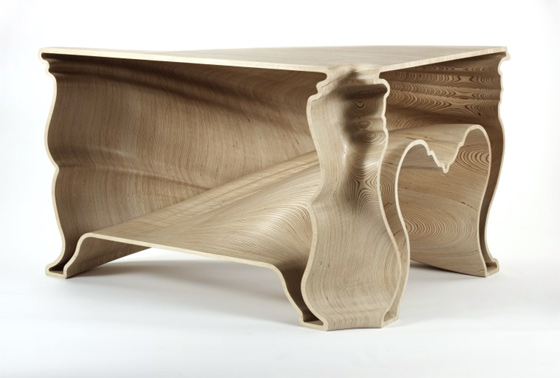
Cinderella Table, Jeroen Verhoeven, 2005. Museum no. W.1-2006
To celebrate a partnership between the V&A and the Crafts Council, we asked leading figures in the craft world to tell us what the term craft means to them

Mark Jones

Director, Victoria & Albert Museum (2001 - 2011)

Craft is remembering that art is seen, felt and heard as well as understood, knowing that not all ideas start with words, thinking with hands as well as head.

Rosy Greenlees

Director, Crafts Council

'Contemporary craft is about making things.  It is an intellectual and physical activity where the maker explores the infinite possibilities of materials and processes to produce unique objects. To see craft is to enter a world of wonderful things which can be challenging, beautiful, sometimes useful, tactile, extraordinary; and to understand and enjoy the energy and care which has gone into their making.'

Laurie Britton-Newell

Curator, ‘Out of the ordinary’ exhibition, V&A,  November 2007

'I use the word craft as an umbrella term, not as the definition of a separate discipline. I find craft difficult when it has an ‘s’ on the end; the crafts implies something clear cut, but it isn’t. When craft is involved with the making of something, be it a pot or a piece of writing, it usually means that the process of how and why it has been put together has been well considered, and generally I prefer it.  Instead of using "that’s cool" people could start saying "that’s craft"!'

Caroline Broadhead

Practitioner

'What craft means to me is the making part, the how you make, and this is an exchange with materials - what you give to a material, and what it gives back. This exchange can be awkward, it can be a struggle, or one party can dominate, but if it is a productive exchange, then that's when it's worth looking at. But ultimately, it is the extra something that makes it special.'

Christopher Frayling

Rector, Royal College of Art

'If you look up the word 'craft' in dictionaries of phrase and fable, the entry will say "see freemasonry".  That's craft as secret knowledge, locked away in some secret place known only to master-craftspeople. Although there's a strong element of tacit knowledge - as distinct from formal knowledge - in all craft activity, this is in fact far from a secret form of knowledge, just a very difficult one to pin down. Making close contact with materials, technical skills plus imagination, tangible results in the form of things, sometimes pushing at the outer limits of function, taking the material for a walk. The American Customs & Excise definition of 'a work of art' is that the owner must be able to prove it is completely useless. Craft work is something else, though it can produce objects for contemplation as well as objects for use.'

Paul Greenhalgh

Director, Corcoran Museum, Washington DC, and editor of ‘The Persistence of Craft’

'Craft has changed its meaning fundamentally at least three times in the last two centuries, and it means fundamentally different things from nation to nation even in the Western world. So there can be no one-liner that identifies larger single meanings, as it doesn't have one. If it is of use in the current context, it is to recognize the significance of genre-based practice in the arts. It should also be a useful category in a global cultural environment. It might even have meaning as a signifier of a socio-political outlook. But it should have nothing to do with aesthetics, and less to do with negative approaches to technology.'

David Revere McFadden

Chief curator and vice president, Museum of Arts & Design, New York

'Craft, art, and design are words heavily laden with cultural baggage. For me, they all connote the profound engagement with materials and process that is central to creativity. Through this engagement form, function, and meaning are made tangible. It is time to move beyond the limitations of terminologies that fragment and separate our appreciation of creative actions, and consider the "behaviors of making" that practitioners share.'

Professor Simon Olding

Director, Crafts Study Centre, Farnham, Surrey

'An expression of human endeavour creatively realised on the borders of utility, design, architecture, sculpture and art. Craft is specific, recognizable and broad enough to carry loaded meaning with good cheer. It means little without its association to the individual maker and the organisations that give it life and value.'

Caroline Roux

Acting editor, Crafts magazine

'Craft has never been more important than now, as an antidote to mass production and as a practice in which the very time is takes to produce an object becomes part of its value in a world that often moves too fast.' "
I agree with this quote by Caroline Roux as mass production increases we lose character to objects and pieces and paying for low quality products that are mass produced with no sentiment or uniqueness. 'Craft' or hand made products are time consuming and creatively designed giving the object character and you're buying someone's speciality skills. Although not everyone can pay for these true craft the market is still large and they're seen as a luxury items that may hold sentiment especially if the object is commisioned work. A lot of people take it upon themselves to create their own objects reading books, magazines and watching youtube videos but there's a huge difference between hand making something for an activity to save money or as a hobby compared to dedicating yourself to career in this field and studying an education in a Craft subject or like myself Applied Arts.

 http://www.vam.ac.uk/content/articles/w/what-is-craft/


Thursday 2nd October, 2014.

In our Brief reading for this module we were assigned to choose a quote from the world of Design, I have selected:

"I think skills are currently really underappreciated in design. Skills are too often thought of as a way of implementing design, whereas I have found the learning of skills to be one of the most important ways of actually changing my way of thinking about things." Darrell Bishop.

I find this quote very true especially in my discipline where knowledge of materials and their properties helps me design an object as properties differ from various materials and processes.
The craft seminar works perfectly alongside this quote because 'craft' books allow people to have access to a step-by-step guide into making something but without the knowledge of solving problems it's very difficult to develop something further or fix something.